
3D Laser Scanning BIM
Enquire Today For A Free No Obligation Quote
At 3D Laser Scanning BIM, we specialise in capturing high-precision spatial data using laser-based instruments to produce detailed digital representations of existing structures or environments.
Building Information Modelling (BIM) refers to the structured creation of digital models that integrate geometry, metadata, and asset information to support design, construction, and facilities management.
Since design coordination and accurate data are fundamental to modern project delivery, combining 3D laser scanning with BIM allows stakeholders to work from verified, intelligent models aligned with real-world site conditions.
Schedule a scan to BIM using our survey technician’s 3D laser scanners today.
What Is 3D Laser Scanning?
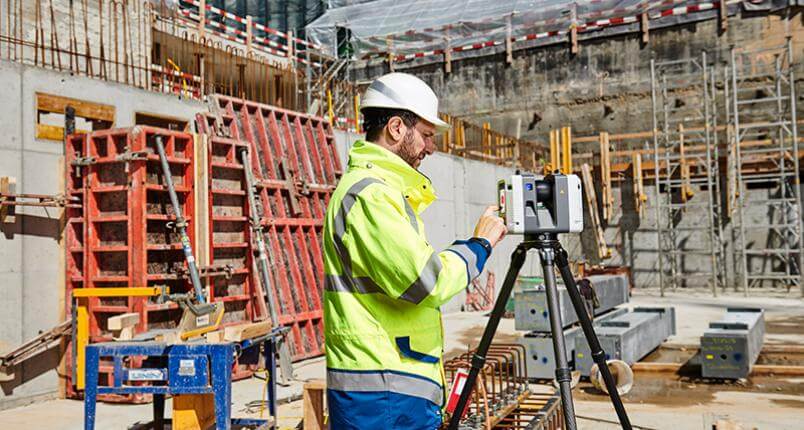
3D laser scanning is a non-invasive method of collecting millions of measurements (known as a point cloud) across surfaces, structures, or terrain.
As the scanner emits laser pulses and records the return signal, it generates a highly detailed and dimensionally accurate record of the built environment.
The result is a dense point cloud model that forms the foundation for 2D drawings, 3D mesh models, or BIM outputs depending on the project requirements.
What Is BIM?
Building Information Modelling (BIM) is a data-rich digital process that supports the design, coordination, and management of construction projects.
A BIM model contains detailed 3D geometry alongside structured data about components, materials, and systems, enabling collaboration between disciplines throughout the project lifecycle.
Since UK government guidelines now require BIM Level 2 compliance for public sector projects, it has become an industry standard in both public and private development
Why Combine 3D Laser Scanning and BIM?
Combining 3D laser scanning with BIM allows for the creation of verified digital models based on actual as-built conditions.
Since traditional surveys may overlook irregularities or rely on manual interpretation, laser scanning ensures that even complex geometries are captured accurately.
By integrating the scan data into BIM software, designers, engineers, and contractors can visualise, coordinate, and plan their works with fewer clashes and greater efficiency.
What’s Included in a 3D Laser Scanning and BIM Survey?
A standard 3D laser scanning and BIM survey includes on-site scanning using static or mobile laser scanners, processing of point cloud data, and the creation of BIM models at the required Level of Detail (LOD).
Survey outputs can include point cloud files (e.g. .rcs, .e57, .las), 3D mesh models or Revit models (LOD 100–LOD 400), 2D drawings extracted from scan data, floor plans, elevations, and sections.
Additionally, we include site verification reports and scan-to-BIM workflows.
Since every project has different requirements, outputs are tailored to suit architectural design, MEP coordination, structural engineering, or facilities management.
How Accurate Is 3D Laser Scanning?
A professionally conducted 3D laser scanning survey provides accuracy typically within ±2 mm to ±10 mm, depending on the scanner specification, site conditions, and scanning range.
As the scan captures physical detail at high resolution, even complex features such as curved walls, voids, or roof structures are documented with precision.
This level of detail reduces rework and provides a verified basis for clash detection, coordination, and digital twin modelling.
How Much Does 3D Laser Scanning and BIM Cost?
The cost of 3D laser scanning and BIM services ranges from £1,000 to £10,000+.
The cost depends on the scale of the project, the required LOD, and the complexity of the structure.
Smaller properties such as retail units or residential conversions may cost £1,000–£2,500, while larger commercial or infrastructure sites requiring full BIM outputs can exceed £5,000–£10,000.
Quotes are prepared based on floor area, number of levels, access requirements, and output format.
Who Needs 3D Laser Scanning and BIM?
A 3D laser scanning and BIM survey is essential for professionals working on:
- Refurbishments or extensions of existing buildings
- Heritage restorations or listed building works
- Large-scale commercial, education, or healthcare developments
- MEP coordination and clash detection
- As-built verification and construction handover
- Facilities management and lifecycle planning
Since the model can be reused and updated throughout the asset lifecycle, the investment in laser scanning and BIM continues to deliver value well beyond the design stage.
What Are the Benefits of 3D Laser Scanning and BIM?
Combining 3D laser scanning with BIM gives you a verified, data-rich model that improves design accuracy, team collaboration, and long-term asset management.
The key benefits include:
- Provides an accurate as-built record of the existing environment
- Enables clash-free design and coordination through intelligent BIM models
- Reduces site visits by giving remote access to verified digital models
- Supports construction staging, scheduling, and costing
- Allows early detection of structural or geometric constraints
- Aligns with UK government BIM Level 2 compliance and ISO 19650 standards
- Facilitates efficient handover and long-term building operation through data integration
As the construction industry moves toward smarter, digital-first practices, 3D laser scanning and BIM deliver the foundation for better outcomes across every project stage.
How Long Does a 3D Laser Scan and BIM Model Take?
A 3D laser scanning and BIM survey can typically be completed within 1–5 days on site, depending on the scale and complexity of the building.
Point cloud processing and BIM model creation usually follow within 1 to 3 weeks, with LOD, deliverables, and project timelines agreed in advance.
For urgent works, fast-track scanning and phased delivery can be arranged to support tight design or planning deadlines.
Can 3D Laser Scanners Be Used Outdoors?
3D laser scanning can be carried out both indoors and outdoors, including facades, rooftops, public spaces, and hard-to-reach areas.
As long-range scanners are effective up to 300 metres or more, they are well-suited for scanning building exteriors, car parks, street furniture, or landscape elements for integration into external BIM or civil design models.
Can a 3D Laser Scanning Survey Be Used for Heritage Projects?
A 3D laser scanning survey is ideal for heritage buildings and conservation work because it captures intricate architectural details without physical contact or alteration to the structure.
Since listed and historic buildings often contain irregular geometry, fragile materials, or undocumented modifications, laser scanning provides a precise digital record for restoration, documentation, or adaptive reuse.
The resulting data can be converted into high-detail CAD drawings or BIM models suitable for planning submissions and conservation-grade design.
What Is a Point Cloud and How Is It Used?
A point cloud is a collection of millions of 3D measurements recorded during a 3D laser scanning survey, each representing an exact point in space on a surface or object.
As the scanner sweeps across the site, it emits laser pulses and measures the time it takes for the light to return, recording XYZ coordinates for every surface it touches.
Point clouds are used as the base data for producing mesh models, BIM models, or 2D drawings, and they can also be viewed directly for inspection or clash detection.
What Is the Level of Detail (LOD) in BIM?
Level of Detail (LOD) refers to the amount of graphical and non-graphical information contained within a BIM model.
Since different stages of a project require varying levels of model complexity, LOD ranges from basic massing (LOD 100) to highly detailed components with construction-ready geometry and embedded data (LOD 400+).
We tailor our BIM outputs to the LOD that suits your design or asset management stage, ensuring the right balance of detail, file size, and usability.
Can 3D Laser Scanning Be Used for Structural Deformation Analysis?
3D laser scanning can be used to assess deformation, settlement, or misalignment in structures over time.
As scans provide millimetre-level measurements, repeat surveys can be compared to detect changes in surface geometry, wall plumb, or floor level.
This is especially valuable for monitoring listed buildings, retaining walls, infrastructure assets, or structures showing signs of movement.
Is 3D Laser Scanning Suitable for MEP Coordination?
A 3D laser scanning and BIM survey is widely used for Mechanical, Electrical and Plumbing (MEP) coordination on retrofit or refurbishment projects.
As existing services may be undocumented or routed through tight spaces, the scan provides an exact digital replica of the environment, allowing MEP engineers to route new installations around existing systems with precision.
We reduce the risk of clashes and significantly improves constructability during on-site installation.
How Long Is the Point Cloud Data Usable For?
The point cloud data from a 3D laser scanning survey remains accurate and usable indefinitely, provided the physical space it represents does not change.
As long as the building or environment is not significantly altered, the data can be reused for future planning, verification, or design changes.
It is common practice to archive scan data for several years, especially for ongoing facility management or phased construction schemes.
Can You Scan Ceiling Voids, Roof Spaces, or Hard-to-Reach Areas?
3D laser scanning can be used to capture ceiling voids, plant rooms, lofts, roof voids, and restricted-access areas where manual measurement would be time-consuming or unsafe.
As the scanner can capture data from a distance, even elevated or confined spaces can be scanned accurately without direct access.
For internal voids or services above ceiling tiles, we recommend ensuring access panels are opened prior to the survey where safe to do so.
Is Scan-to-BIM the Same as Creating a Model from Scratch?
Scan-to-BIM involves building a digital model based on real-world geometry captured during a 3D laser scanning survey, whereas traditional BIM modelling is often based on drawings or conceptual designs.
Since scan-to-BIM uses verified geometry as its starting point, the resulting model accurately reflects the as-built condition of the space.
This method is especially useful for refurbishment, retrofitting, and documentation of existing assets.
Can You Deliver the Survey in Revit Format?
We regularly deliver BIM models in Revit format following a 3D laser scanning survey, and we also support other industry-standard formats such as IFC, Navisworks, and AutoCAD.
As many architects and engineers use Revit for design and coordination, we align the model structure and naming conventions with client standards or BIM execution plans (BEPs).
LOD requirements, families, and layering can all be customised to ensure full compatibility.
Is 3D Laser Scanning Disruptive to Building Occupants?
3D laser scanning is a non-invasive and quiet process, making it suitable for live environments such as offices, schools, healthcare facilities, or occupied buildings.
As the scanner operates silently and requires only line-of-sight to the target surface, it causes minimal disruption and can be scheduled during low-traffic hours if needed.
We follow strict health and safety protocols and can provide risk assessments for occupied sites.
Request a Free Quote for 3D Laser Scanning to BIM Today
A 3D laser scanning and BIM survey offers a detailed and intelligent digital replica of your building or site, providing the clarity and accuracy required for modern construction and design projects.
As risks associated with inaccurate measurements, design clashes, and unforeseen conditions continue to affect project timelines, verified scan data and BIM coordination reduce these challenges significantly.
Whether you’re designing, building, managing, or refurbishing, our 3D scanning and BIM services give you the tools to make confident, data-driven decisions.
Get a free quote for 3D laser scanning and BIM today, and take the first step towards better digital design and asset management.
Find More Info
Make sure you contact us today for a number of great 3D laser scanning and BIM services.
For more information on 3D Laser Scanning and BIM, fill in the contact form below to receive a free quote today.
★★★★★
We commissioned 3D Laser Scanning and BIM for a listed building refurbishment in Bath, and the results were exceptional. The level of detail in the point cloud and BIM model gave our design team absolute confidence in every measurement. Their professionalism and communication throughout the process made coordination between disciplines much smoother.
James Whitfield
Greater London
★★★★★
3D Laser Scanning and BIM supported us on a large healthcare extension in Manchester, providing accurate scan-to-BIM models that saved us countless hours on-site. The survey data was delivered promptly and integrated seamlessly with our Revit workflow. I’d highly recommend their team for any project where precision and reliability matter.
Rachel Dunmore
Greater London